Core beliefs in Islam
Awaiting scholar review
What every Muslim believes: the oneness of God (tawhid), the six articles of faith, and what those beliefs change about an ordinary day.
Tawhid: the oneness of God
Tawhid is the belief in the absolute oneness of Allah (Glossary) (God). It sits at the center of Islam (Glossary), and every other part of the faith rests on it. When you said the Shahada (Glossary), "La ilaha illallah, Muhammadur Rasulullah" (There is no god but Allah, and Muhammad is the Messenger of Allah), tawhid (Glossary) is what you affirmed.
Tawhid means Allah is one, unique, and without partners. He was not born and has no children. Nothing in creation resembles Him, and His essence is past what a human mind can hold, though you can come to know Him through His names and attributes. One entire surah is given to this: Surah Al-Ikhlas (Chapter 112) says, "Say, He is Allah, the One. Allah, the Eternal Refuge. He neither begets nor is born, nor is there to Him any equivalent."
If you came to Islam from another faith tradition, tawhid can feel like a weight coming off. All of your worship and reliance goes to one place. There is no intermediary and no saint to pass your prayers through, so your relationship with Allah is direct and personal.
Tawhid also changes ordinary decisions. No person, no possession, and no job title deserves the devotion that belongs to Allah alone. That takes the pressure off trying to please everyone, and off chasing things that were never going to satisfy you. Your footing stops depending on how the week is going.
Worshipping Allah alone
People come to Islam from every background, and the next section covers faiths other than Christianity. If you grew up Christian, you may have loved Jesus (peace be upon him) all your life, and you do not have to stop. Muslims honour him as one of the greatest prophets. The Quran describes him saying, "Indeed, I am the servant of Allah" (19:30, translation of meaning), and he called people to worship God alone.
The first half of the Shahada, "there is no god worthy of worship except Allah", turns that into daily practice. In every prayer you say, "It is You we worship and You we ask for help" (1:5). Surah Al-Ikhlas (112) describes the One you worship: Allah, the Eternal Refuge, who neither begets nor is born, with nothing equal to Him.
What this changes in practice:
- You pray to Allah directly, and your personal dua can be in English or any language.
- Prayer and worship go to Allah alone: not to Jesus, Mary, saints or angels, not to the Prophet Muhammad, and not at graves.
- Nobody has to pass your prayers on for you. Allah hears you.
Giving any worship to someone besides Allah is called shirk, and the Quran treats it very seriously: "Indeed, Allah does not forgive association with Him, but He forgives what is less than that for whom He wills" (4:48). That verse is about where you are heading, not a reason to punish yourself over the past. The Quran says past wrongs are forgiven for those who stop (8:38), and the Prophet said that Islam wipes out what came before it (Sahih Muslim 121). What you did before Islam is forgiven.
Things you owned before Islam. A Bible or other religious books can stay on your shelf: a SeekersGuidance answer says owning them is not sinful in itself, and borrowed copies go back to their owner. For crosses, statues and family heirlooms, ask a teacher before you do anything, and never destroy something that matters to your family. The Quran tells Muslims not to insult what others worship (6:108).
Worship is different from being with your family. Sitting with your family at a meal, visiting over the holidays, or looking after a relative is keeping family ties, which the Quran asks of you (31:15 and 60:8). Joining in prayers or a religious service directed to anyone other than Allah is the part you step out of.
Church weddings and funerals. Scholars answer this differently, and it is fine to ask before you decide:
- Egypt's Dar al-Ifta and an AMJA scholar say you may attend a relative's funeral, even in a church, as part of keeping family ties.
- SeekersGuidance answers from the Hanafi school allow the family gathering but advise against attending the church service itself without a strong need.
- IslamQA takes a strict view, including on attending a church wedding.
None of these answers has you join in worship, and all of them fit the Quran's call to keep treating your family kindly. Your situation matters, so ask a local imam or scholar you trust before the event. Our holidays and family occasions guide has scripts for these conversations.
If you come from another faith or from no religion
Much of what new Muslims read assumes a Christian upbringing. In a 2025 Yaqeen Institute survey of 618 converts in the United States, 60% were raised Christian. About 19% grew up with no religion, and about 20% came from Jewish, Buddhist, Hindu or other traditions. So roughly two in five did not start from Christianity.
The principle is the same for everyone. Your worship goes to Allah alone, and your family still gets your kindness and company (31:15 and 60:8). The Quran also tells Muslims not to insult what other people call on besides Allah (6:108), so there is no need to mock your family's gods to prove you are sincere.
A shrine or statues at home. We did not find a scholarly answer written for a new Muslim living in a family home with a shrine. The closest is a Shafi'i answer from SeekersGuidance (Shaykh Jamir Meah) about a temporary stay in a friend's home where the main objects had been put away. It says staying in a room with statues is disliked in the reliable Shafi'i view, while another Shafi'i view says it is not allowed, and it advises staying clear where you can. Other schools were not checked. Do not break or hide family property, and ask a teacher about your own home.
Food offered in worship (prasad and similar). A SeekersGuidance answer by Mawlana Ilyas Patel, using Hanafi reasoning, says food offered at a temple in the name of someone other than Allah is not eaten. Decline it politely. If you are handed some by mistake, the answer says you may give it to a non-Muslim. Ordinary family cooking is a separate question, covered in the halal living topic.
Karma and rebirth. Islam agrees that deeds have results: "So whoever does an atom's weight of good will see it, and whoever does an atom's weight of evil will see it" (99:7-8). A SeekersGuidance answer by Ustadh Abdullah Anik Misra explains that Islam does not teach rebirth or an impersonal law of karma. There is one life, and every outcome is from Allah.
Yoga and meditation. Shaykh Faraz Rabbani (SeekersGuidance) writes, "When yoga is practiced purely for the element of physical exercise, then there is no harm in it." The meditative and spiritual parts are left out.
Smudging and Indigenous ceremonies. A SeekersGuidance answer by Shaykh Irshaad Sedick says burning sage for its smell or for health is fine, but smudging done for spiritual protection clashes with relying on Allah. That answer was not written with First Nations, Inuit or Metis communities in mind. Your identity and your family's culture stay yours. For questions about particular ceremonies, talk to a teacher, and if you can, to Indigenous Muslims who have faced the same questions.
Ancestor rites and family graves. We did not find a named scholarly answer on ancestor rites such as incense at family graves or Qingming. Keep caring for your family and for your relatives' graves, and ask a teacher before the next family rite.
Festivals such as Diwali, Vaisakhi, Lunar New Year, Nowruz and Hanukkah. The holidays and family occasions guide explains the line between family time and worship, with what we found for each festival.
Coming from no religion. Talking to a God you have only just come to believe in can feel strange. The Prophet said every child is born on the fitrah (Glossary), a natural inclination to recognise God (Sahih al-Bukhari 1385; see also 30:30). You can talk to Allah in your own words, in any language.
Coming from a Jewish background. Moses (Musa) and the Torah are honoured in Islam, and much of what you know about the prophets will be familiar. The sections further down on prophets and on Jesus, Mary and the earlier scriptures explain where Islam agrees and where it differs.
A few practical steps:
- Tell your family you still love and respect them before you explain what you will step out of.
- Decide before the next family rite what you will do: attend without taking part, help with the food, or visit before or after.
- Ask a local imam about the exact festival or rite in your family.
The six articles of faith
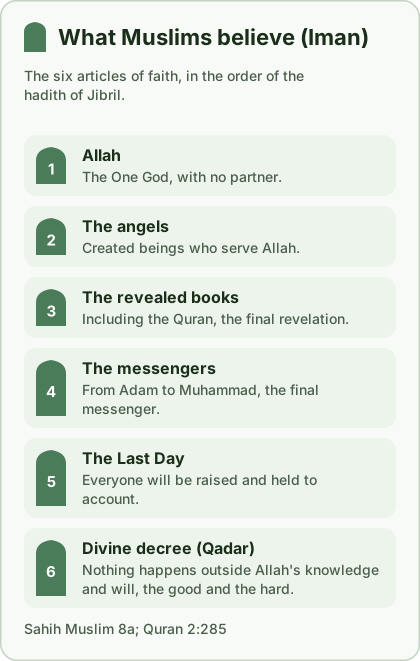
Muslims hold six articles of faith (arkan al-iman). Together they are what iman (faith) actually consists of:
1. Belief in Allah: One God, the Creator, Sustainer, and Sovereign of everything that exists. Allah has names and attributes that tell you who He is: the Most Merciful, the All-Knowing, the All-Powerful, the Just, and more. Learning Allah through those names is some of the most rewarding study you will do.
2. Belief in the angels: Angels are beings Allah created from light who carry out His commands. Jibreel (Gabriel) brought the Quran to the Prophet Muhammad, Mika'il (Michael) is responsible for rain and sustenance, and other angels record your deeds, protect you, and will be present on the Day of Judgment. Angels do not have free will the way humans do, and they worship Allah without pause.
3. Belief in the divine books: Allah sent scriptures to guide people throughout history. They include the scrolls of Ibrahim (Abraham), the Torah given to Musa (Moses), the Zabur (Psalms) given to Dawud (David), the Injil (Gospel) given to Isa (Jesus), and finally the Quran given to Muhammad (peace be upon them all). Muslims hold that the Quran is the final, preserved revelation, confirming and completing the messages before it.
4. Belief in the prophets and messengers: Allah sent prophets to every nation to call people back to the truth. Muslims believe in all of them, from Adam to Muhammad, including Nuh (Noah), Ibrahim (Abraham), Musa (Moses), and Isa (Jesus). Muhammad (peace be upon him) is the final prophet, and his message is for all of humanity.
5. Belief in the Day of Judgment: There will be a day when everyone is raised and held accountable for what they did. Those who lived righteously are rewarded with Paradise, and those who rejected the truth and kept to wrongdoing face the consequences. This is why your choices matter past this temporary world.
6. Belief in qadar (divine decree): Allah knows everything that has happened and everything that will happen. Nothing occurs outside His knowledge and permission. This does not cancel human free will, and you are still answerable for your choices. What it does mean is that you can trust there is wisdom in how things unfold, even when you cannot see it. For many people this is the article of faith that carries them through the hardest stretches.
Understanding Allah's names and attributes
Learning Allah's names and attributes is one of the steadiest ways to grow in faith. Knowing the names goes past memorising the words. It means understanding what they mean and letting them shape how you live.
A few of the names tend to matter most to new Muslims:
- Ar-Rahman (The Most Gracious) and Ar-Raheem (The Most Merciful). These two open almost every surah in the Quran. Allah's mercy covers everything. Whatever sits in your past, His mercy is larger than it.
- Al-Ghaffar (The Repeatedly Forgiving). Allah does not forgive once and then stop. He forgives again and again, which is worth knowing while you are new and still making mistakes.
- Al-Wadud (The Most Loving). Allah loves His creation and loves those who turn to Him. Love belongs in your relationship with Him alongside awe.
- As-Sabur (The Patient). Allah is patient with His creation and gives people time and chances to come back to Him.
- Al-Hakeem (The All-Wise). There is wisdom behind everything Allah decrees, even when that wisdom is not visible to us yet.
Many Muslims take one name at a time and sit with its meaning through the day. You might keep Ar-Rahman for a week and watch for where mercy shows up in your life. After a while the names stop being vocabulary and start being something you have actually felt.
The names between them cover every human need. When you are afraid, Allah is Al-Muhaymin (The Protector). When you feel lost, He is Al-Hadi (The Guide). When money is short, He is Ar-Razzaq (The Provider).
Prophets in Islam
Muslims believe Allah sent prophets and messengers to every nation through history, and all of them carried the same core message: worship the one true God and live righteously. The Quran names 25 prophets, while indicating there were many more.
If you come from a Christian or Jewish background, many of these names will already be familiar. Adam, Noah (Nuh), Abraham (Ibrahim), Moses (Musa), David (Dawud), Solomon (Sulayman), and Jesus (Isa) are all honored prophets in Islam. Reading their stories from the Islamic side is worth doing slowly, since some details match what you grew up with and some do not.
A few things to hold onto about prophets in Islam:
- All prophets taught tawhid, the oneness of God. The core message never changed. What changed were the specific laws and practices, updated for different times and peoples.
- Prophets were human beings. They ate, slept, had families, and went through hardship. Their humanity is the point, because it means you can actually follow their example.
- Prophets were protected from major sins. They were the best of their people and divinely guided, though still human, and small errors were possible.
- Muhammad is the final prophet. Muslims hold that no prophet comes after Muhammad (peace be upon him). His message, kept in the Quran and in his teachings (Sunnah), is for everyone until the end of time.
The stories of the prophets carry lesson after lesson about patience, trust in Allah, and courage under pressure. New Muslims often find the story of Ibrahim (Abraham) the most comforting one, because he had to leave everything familiar behind to follow Allah's guidance. If that sounds close to where you are standing right now, you are reading it correctly.
The Quran says: "We have not sent you (O Muhammad) except as a mercy to the worlds" (21:107). That verse is how Muslims see the Prophet Muhammad: a mercy, and a guide for all of humanity.
Jesus, Mary and the earlier scriptures
If your family is Christian or Jewish, these are often the first questions they ask. Here is what Muslims believe, in words you can share.
Jesus (Isa). Muslims love and honour Jesus, peace be upon him. The Quran calls him the Messiah, a messenger of Allah and His word given to Mary (4:171), and says he is honoured in this world and the next (3:45). Muslims do not believe he is God or the son of God: the same verse says Allah is one God, far above having a son (4:171).
Mary (Maryam). A whole surah of the Quran carries her name. The Prophet (peace be upon him) named her among the best of women (Sahih al-Bukhari 3432).
The cross. The Quran says Jesus was not killed and was not crucified (4:157). This is a real difference from Christian belief. Say it gently, and only when someone asks. The Prophet also said that Jesus son of Mary will come down again and judge with justice (Sahih al-Bukhari 3448).
The Torah and the Gospel. Muslims believe Allah gave the Torah to Moses and the Gospel (Injil) to Jesus, with guidance and light (5:46). For what is in the Bible as it is read today, the Prophet taught Muslims neither to confirm nor to deny the reports of Jews and Christians, and to say, "We believe in Allah and what is revealed to us" (Sahih al-Bukhari 4485).
Reading the Bible yourself. A SeekersGuidance answer by Shaykh Abdul-Rahim Reasat says reading it may be permissible if you understand your own belief well and are not prone to doubts, and advises against going online to look for problems in it. It is usually better left for later, with a teacher.
Talking with your family. The Quran tells Muslims to speak with Jews and Christians "in a way that is best" and to say, "our God and your God is one" (29:46). Start with what you still share: belief in God, the prophets, Mary and Jesus. Answer one question at a time and offer to come back to the rest. Leave arguments about Bible manuscripts for later study with a teacher. Debate videos are not a script for talking with people you love, and nobody in your family needs to hear that they are bad people. Yaqeen Institute's article "Who is Jesus in Islam?" is a good next read.
The afterlife and accountability
Belief in the afterlife runs through the whole of Islamic faith. This worldly life is temporary: a test, and a chance to grow closer to Allah through worship and doing right by people. The lasting life comes after this one.
The afterlife has several stages:
The life of the grave (Barzakh): After death the soul enters a state called Barzakh, a realm in between this life and the Day of Judgment. The righteous find peace and comfort there, while those who rejected the truth may find difficulty.
The Day of Judgment (Yawm al-Qiyamah): All of creation is gathered before Allah. Every person is shown their deeds, good and bad, and judged with perfect justice. The Quran describes that day in close detail and keeps returning to one point: nothing is hidden from Allah.
Paradise (Jannah) and Hellfire (Jahannam): Those who believed and lived righteously enter Paradise, a place of lasting joy, peace, and closeness to Allah that no description quite reaches. Those who rejected faith and kept to wrongdoing face Hellfire. Allah's mercy is vast, though, and He forgives whom He wills.
Accountability can feel sobering and motivating at the same time. It means your life has a purpose and your choices land somewhere. Every act of kindness, every prayer, every moment of patience counts. Hold that next to hope in Allah's mercy rather than carrying it on its own. The Quran keeps pairing its warnings with reassurance: "My mercy encompasses all things" (7:156).
This belief is here to give life direction, not to make you anxious. Once you know this world is not all there is, the pressure to squeeze every bit of happiness out of it comes off. Hardship gets easier to sit with because it has an end. And you can do good quietly, without anyone noticing, because Allah already saw it.
Qadar: understanding divine decree
Qadar (divine decree or predestination) is the article of faith people ask about most, and the hardest of the six to state simply. Qadar means Allah has complete knowledge of everything, past and present and future, and that nothing happens outside His knowledge and permission.
There are four parts to it:
- Allah's knowledge: Allah knows everything that has happened, is happening, and will happen. His knowledge is complete and perfect.
- Allah's writing: Everything is recorded in a preserved tablet (Al-Lawh Al-Mahfuz).
- Allah's will: Nothing happens in creation except by Allah's will.
- Allah's creation: Allah is the Creator of everything, including our actions.
"But what about free will?" Fair question, and a very common one. Islam teaches that humans have genuine free will and make real choices. You decide whether to be honest or dishonest, whether to pray, whether to be kind or cruel, and you answer for those decisions. Qadar does not make you a puppet. It means Allah, in His infinite knowledge, already knows what you will choose, and He still leaves the choosing to you.
Think of a teacher who knows a student well enough to predict exactly how they will answer a question. The teacher knowing does not make the student answer that way. The student still answers freely. Allah's knowledge is far beyond any teacher's, but the same principle holds: knowing a choice in advance does not remove it.
Believing in qadar changes how loss feels. When you lose a job, or get sick, or get turned down, you can rest on the fact that there is wisdom in it even if none of that wisdom is visible yet. And when things go well, gratitude comes more easily than swagger.
The unseen, without fear
Muslims believe in the unseen, including angels and jinn (Glossary). The Prophet (peace be upon him) said, "The influence of an evil eye is a fact" (Sahih Muslim 2188). None of this is meant to make you afraid, and not every hardship is the evil eye or a jinn.
Daily protection is simple, and you can do it yourself: your prayers, the morning and evening remembrance, the Verse of the Throne (Ayat al-Kursi), and the last two chapters of the Quran, Al-Falaq and An-Nas. The Islamweb Fatwa Centre recommends these in its answer on amulets. The dua and dhikr tool has the words.
Healing recitation (ruqya) and amulets (taweez)
Healing recitation (ruqya) means reciting the Quran and duas over someone who is ill. The Prophet said there is no harm in it as long as it contains no shirk (Glossary) (Sahih Muslim 2200). You can recite it over yourself. Taking payment for ruqya is allowed in principle: some companions recited Al-Fatiha over a man who had been stung, and the Prophet approved the payment (Sahih al-Bukhari 2276). Exploiting a frightened person is another matter.
Amulets (taweez) are a real difference between scholars. Ibn Mas'ud reported the Prophet saying that spells, charms and love potions are shirk (Sunan Abi Dawud 3883). Islamweb's answer says scholars differ on amulets that contain only Quran, and that most of them hold these are not allowed either. A Shafi'i answer at SeekersGuidance permits them under three conditions: they contain only Allah's words, names or attributes, they are in Arabic, and the person believes that only Allah has any effect.
A beginner does not need an amulet. If the question comes up, ask your teacher.
Fortune tellers and bad dreams
Fortune tellers, palm readers and horoscopes are off limits. The Prophet said that whoever goes to a diviner and asks about anything, their prayer is not accepted for forty nights (Sahih Muslim 2230).
A good dream is from Allah and a bad dream is from Satan. After a bad dream, seek refuge in Allah and spit lightly to your left three times, and it will not harm you (Sahih Muslim 2261a). Try not to dwell on it. You do not need an online dream interpreter.
Health first, and warning signs of paid healers
Persistent low mood, panic, hearing voices, or not being able to get through the day need a doctor or a counsellor, whatever else you believe is going on. A 2013 paper in The Psychiatrist, a UK journal, argues that clinicians and imams should work together on care that covers the body, the mind and the spirit. In an emergency, call 911. If you are thinking about suicide or worried about someone, call or text 9-8-8.
Some paid healers exploit people at their lowest. This list is practical safety advice from this site, not a ruling. Slow down if a healer:
- asks for large or repeated fees, or the sessions never end
- wants to see you alone behind closed doors, or touches you
- says only they can cure you
- tells you to stop your medication or not to see a doctor
- asks you to keep it secret
- blames a family member for your illness
Talk to someone you trust. Fraud can be reported to the police and the Canadian Anti-Fraud Centre, as the red flags guide explains. Rulings on ruqya and amulets, and the mental health side of this, are for a qualified teacher and a clinician to guide you through.
Where to go next
- Dua and dhikrThe morning and evening remembrance, Ayat al-Kursi, Al-Falaq and An-Nas.
- Red flags and staying safeHow to spot and report people who exploit new Muslims.
- Mental health supportCrisis lines and faith-aware counsellors in Canada.
- Family who are not MuslimWhat Muslims can hope and pray for relatives who are not Muslim.
- Grief and lossTears, mourning and duas when someone dies.
Related steps
Terms to know
- Allahالله
- The Arabic word for God. Muslims use this name for the one Creator and Sustainer of everything that exists. Arabic-speaking Christians and Jews use the same word for God.
- Islamإسلام
- The religion of submission and peace with God. The word comes from the Arabic root meaning 'peace' and 'submission.' Islam teaches that there is one God and that Muhammad is His final messenger.
- Imanإيمان
- Faith or belief. In Islam, iman covers believing in Allah, His angels, His books, His messengers, the Day of Judgment, and divine decree. It rises and falls in everyone, and looking after it is lifelong work.
- Aqeedahعقيدة
- The core beliefs and creed of Islam: one God, the angels, the revealed books, the prophets, the Day of Judgment, and divine decree. It is the foundation the rest of the religion rests on.
- Shahadaشهادة
- The declaration of faith and the first pillar of Islam: 'I bear witness that there is no god but Allah, and Muhammad is His messenger.' Saying it sincerely is how a person enters Islam. Everything else comes after it.
- Tawhidتوحيد
- The absolute oneness of Allah and singling Him out alone for worship. It is the foundation of Islamic belief.
- Shirkشرك
- Associating partners with Allah in worship, lordship, or His unique attributes. It is considered the gravest sin if a person dies without repenting from it.
- Fitrahفطرة
- The natural, pure state every human being is born in, already inclined to recognize God. Islam teaches that coming to faith is a return to that original nature rather than a move to something foreign.
- Jinnجن
- Unseen beings created from smokeless fire who, like humans, have free will. Some are believing and some are not.
Resources
Welcome to Islam: A Step-by-Step Guide for New Muslims
BookA short guide by Mustafa Umar for your first month as a Muslim, covering the basics and the difficulties new Muslims often face.
Source: Mustafa Umar
Best for: Your first days and weeks after shahada
32 pages and free to read online. The author is an imam and a member of the Fiqh Council of North America.
Yaqeen Institute for Islamic Research
VideoArticles, videos, and infographics that answer faith questions, doubts, and spirituality with sourced research.
Source: Yaqeen Institute
Best for: Faith questions and deeper reflection
Helpful for learning context without turning early Islam into debate overload.
WhyIslam
CommunityPlain introductions to Islam, one-on-one conversations, and support material for new Muslims.
Source: WhyIslam
Best for: Simple explanations for you or family members
Useful for gentle public education and first questions.
New Muslim Guide
ArticleA broad online guide that covers worship, beliefs, manners, and the everyday basics.
Source: New Muslim Guide
Best for: One-stop beginner reference
Best used for foundations, not as a personalized fatwa source.
SeekersGuidance
ArticleFree courses and a question-and-answer service on the Islamic sciences, taught by qualified scholars.
Source: SeekersGuidance
Best for: Learning with qualified teachers
Good for structured knowledge. Ask locally about your own circumstances.
Being Muslim: A Practical Guide
BookA practical handbook on worship, spirituality, and community life, written for new and returning Muslims.
Source: Sandala
Best for: A calm physical book for foundations
Use as general education and pair it with a local teacher for personal questions.
Seerah Series by Yasir Qadhi
VideoA long, detailed lecture series on the life of Prophet Muhammad, peace be upon him.
Source: Yasir Qadhi
Best for: Long-form seerah listening
This goes deeper than a first-week resource. Take it slowly.
AboutIslam - New Muslims
ArticleShort articles and FAQs for new Muslims working through questions about faith, identity, family, and community.
Source: AboutIslam
Best for: Short beginner articles
Use as supportive reading and confirm detailed rulings with qualified scholars.
Essentials of Faith, Worship, and Spirituality
VideoA free live Level One course on the basics of belief, worship and spirituality, on Saturdays at 10:00 Eastern time.
Source: SeekersGuidance
Best for: A first structured course, one or two months in
Taught by Shaykh Faraz Rabbani. SeekersGuidance says all its courses are free.
Sources used
These sources support the general topic guidance. For personal rulings or sensitive situations, ask a qualified local imam, scholar, clinician, or professional as appropriate.
- Quran 112 - Surah al-IkhlasQuran source
Quran.com - Quran text and translation reference
Used as a short-surah example in the Salah Companion. The English wording is a translation of the meaning.
- Quran 1 - Surah al-FatihahQuran source
Quran.com - Quran text and translation reference
The source for the Al-Fatiha Arabic text, used in prayer recitation and in the dua for guidance. The English wording is a translation of the meaning.
Quran.com - Quran text and translation reference
Cited for: Jesus says, I am the servant of Allah. The English wording is a translation of the meaning, checked against Saheeh International (checked via api.alquran.cloud).
Quran.com - Quran text and translation reference
Cited for: Allah forgives what is less than associating partners with Him. The English wording is a translation of the meaning, checked against Saheeh International (checked via api.alquran.cloud).
Quran.com - Quran text and translation reference
Cited for: past wrongs forgiven for those who stop. The English wording is a translation of the meaning, checked against Saheeh International (checked via api.alquran.cloud).
- Quran 31:15: Keep your parents' company kindlyQuran source
Quran.com - Quran text and translation reference
Cited for: keep your parents' company kindly. The English wording is a translation of the meaning, checked against The Clear Quran.
Quran.com - Quran text and translation reference
Cited for: kindness and fairness to those who do not fight you. The English wording is a translation of the meaning, checked against The Clear Quran.
- Quran 21:107 - Mercy to the worldsQuran source
Quran.com - Quran text and translation reference
Used in the Prophet Muhammad topic for what mercy meant in his mission. The English wording is a translation of the meaning.
- Sahih Muslim 121: Islam wipes out what came beforeHadith reference
Sunnah.com - Hadith reference
In Sahih Muslim. Cited for: Islam wipes out what came before.
- Sahih Muslim 8a: The hadith of JibrilHadith reference
Sunnah.com - Hadith reference
In Sahih Muslim. Cited for: the hadith of Jibril.
- The Six Pillars of Faith (Eemaan)Beginner guide
New Muslim Guide - Beginner guide
Supports: Explanation of each article.
- Who is Jesus in Islam?Research education
Yaqeen Institute - Research education
Supports: Jesus's honoured status; he taught worship of God alone.
- No Intermediaries between God and ManBeginner guide
New Muslim Guide - Beginner guide
Supports: Direct worship of Allah without intermediaries.
- Belief in Allah (part 2 of 2): shirk, the opposite of tawheedBeginner education
NewMuslims.com - Beginner lesson
Supports: that prayer and worship go to Allah alone, not to Jesus, Mary, saints, angels, the Prophet Muhammad or graves. Cites Quran 4:48 and 51:56. Theology written for readers from other faiths; needs scholarly review before quoting.
- Why Is Shirk the Greatest Sin of All?Research education
Yaqeen Institute - Research education
Supports: Definition of shirk and its seriousness.
- A Muslim attending the funeral of a non-MuslimScholar answer
Dar al-Ifta al-Misriyyah (Egypt) - Fatwa body answer
Supports: Permission to attend a relative's church funeral.
- Can A Muslim Attend A Non-Muslim Funeral?Scholar answer
Assembly of Muslim Jurists of America (AMJA) - Scholar answer
Supports: Permission to attend non-Muslim funerals.
SeekersGuidance - Scholar answer
Supports: Attend family gatherings, avoid religious rites.
- Can I Go to Church with a Friend?Scholar answer
SeekersGuidance - Scholar answer
Supports: Hanafi view against entering churches without strong need.
- Convert attending his brother's wedding partyScholar answer
Islam Question and Answer - Scholar answer
Supports: Strict view.
- Owning or Gifting Books on Other ReligionsScholar answer
SeekersGuidance - Scholar answer
Ustadh Farid Dingle, checked by Shaykh Faraz Rabbani, 22 April 2021. Supports: owning books of other religions is not sinful in itself; the concern is only if reading them is likely to lead to disbelief; borrowed or institutional copies must be returned.
- Quran 6:108: Do not insult what others worshipQuran source
Quran.com - Quran text and translation reference
Cited for: Muslims do not insult what other people call on besides Allah, so a new Muslim treats family religious items and practices with respect. The English wording is a translation of the meaning (Saheeh International).
- Becoming Muslim: The Lives of American Converts to IslamResearch education
Yaqeen Institute - Convert experience report
A 2025 report by Dr. Osman Umarji, Anna Birawi, Dr. Tamer Desouky and Shaykh Abdullah Oduro, based on a survey of 618 converts in the United States. Cited for convert identity, family dynamics, cultural belonging, the support mosques, imams and Muslim friends give, and care that continues after conversion. The sample is American, not Canadian. The old new.yaqeeninstitute.org address no longer works; this address redirects to yaqeeninstitute.ca. Checked on 23 September 2026. Page 128: 63% of women converts wear hijab; of those, 46% began at conversion, 30% months later and 24% a year or more later (shares of hijab-wearing women only). Pages 19 to 20: 89% had some college education. Checked on 25 September 2026.
- Is It Permissible for a Muslim to Permanently Stay at a House Containing Hindu Idols? [Shafi'i]Scholar answer
SeekersGuidance - Scholar answer
Shaykh Jamir Meah, 28 December 2016. Supports: a Shafi'i answer about a temporary stay (a year or two) in a friend's home where the main objects had been put away. Staying in a room with statues of animate beings is disliked in the reliable Shafi'i view, and another Shafi'i view says it is impermissible; it is permissible without dislike if they are elsewhere in the building; 'as a general rule, it is always better for a Muslim to stay clear'. It is not a ruling about living in a family home with a shrine.
SeekersGuidance - Scholar answer
Mawlana Ilyas Patel, checked by Shaykh Abdul-Rahim Reasat, 22 December 2024. Supports: food offered at a temple in the name of other than Allah is not eaten (Hanafi reasoning from Mufti Shafi's Ma'arif al-Quran); if received by mistake it may be given to a non-Muslim; decline respectfully and keep relations peaceful.
- Does the Concept of Karma Exist in Islam?Scholar answer
SeekersGuidance - Scholar answer
Ustadh Abdullah Anik Misra, checked by Faraz Rabbani, 15 November 2012. Supports: Islam affirms that deeds have consequences but rejects reincarnation and an impersonal karma system; all outcomes are from Allah. The page cites the verse as 100:7-8; the correct reference is 99:7-8, which this site cites from Quran.com.
- Quran 99:7-8: An atom's weight of good or evilQuran source
Quran.com - Quran text and translation reference
Cited for: whoever does an atom's weight of good will see it, and whoever does an atom's weight of evil will see it; deeds have consequences, answered to Allah. The English wording is a translation of the meaning (Saheeh International).
- What is the Ruling of Yoga?Scholar answer
SeekersGuidance - Scholar answer
Shaykh Faraz Rabbani, 25 December 2012. Supports: 'When yoga is practiced purely for the element of physical exercise, then there is no harm in it'; its meditative and spiritual elements are avoided.
SeekersGuidance - Scholar answer
Shaykh Irshaad Sedick, checked by Shaykh Mohammad Abu Bakr Badhib, 13 April 2025. Supports: burning sage for fragrance or health is permissible; smudging done with the belief that it gives spiritual protection or connects to unseen forces conflicts with reliance on Allah and is avoided. Not written with Canadian Indigenous communities in mind.
- Sahih al-Bukhari 1385: Every child is born on the fitrahHadith reference
Sunnah.com - Hadith reference
Sahih al-Bukhari 1385, in Sahih al-Bukhari (sahih). Cited for: every child is born on the fitrah (natural disposition), and the parents raise the child into another religion.
- Quran 30:30: The fitrah of AllahQuran source
Quran.com - Quran text and translation reference
Cited for: the fitrah of Allah upon which He created all people. The English wording is a translation of the meaning (Saheeh International).
- Quran 4:157: Jesus was not killed or crucifiedQuran source
Quran.com - Quran text and translation reference
Cited for: 'they did not kill him, nor did they crucify him'. The English wording is a translation of the meaning (Saheeh International).
Quran.com - Quran text and translation reference
Cited for: Jesus is the Messiah, a messenger of Allah and His word directed to Mary; Allah is one God, exalted above having a son. The English wording is a translation of the meaning (Saheeh International).
Quran.com - Quran text and translation reference
Cited for: Jesus the Messiah, son of Mary, distinguished in this world and the Hereafter. The English wording is a translation of the meaning (Saheeh International).
- Quran 5:46: The Gospel given to JesusQuran source
Quran.com - Quran text and translation reference
Cited for: Allah gave Jesus the Gospel, with guidance and light, confirming the Torah before it. The English wording is a translation of the meaning (Saheeh International).
Quran.com - Quran text and translation reference
Cited for: discuss with Jews and Christians only in the best way, and say 'our God and your God is one'. The English wording is a translation of the meaning (Saheeh International).
Sunnah.com - Hadith reference
Sahih al-Bukhari 4485, in Sahih al-Bukhari (sahih). Cited for: Muslims neither affirm nor deny unverified reports from the People of the Book, and say 'We believe in Allah and what is revealed to us'.
- Sahih al-Bukhari 3432: Mary among the best of womenHadith reference
Sunnah.com - Hadith reference
Sahih al-Bukhari 3432, in Sahih al-Bukhari (sahih). Cited for: Mary is named among the best of the world's women.
- Sahih al-Bukhari 3448: The return of JesusHadith reference
Sunnah.com - Hadith reference
Sahih al-Bukhari 3448, in Sahih al-Bukhari (sahih). Cited for: Jesus son of Mary will descend and judge justly.
SeekersGuidance - Scholar answer
Shaykh Abdul-Rahim Reasat, checked by Shaykh Faraz Rabbani, 1 January 2024. Supports: reading the Bible may be permissible for someone who understands their own creed well and is not prone to doubts or confusion; 'Don't go online trying to find issues'. The answer's polemical reading list is not used on this site.
- Sahih Muslim 2188: The evil eye is realHadith reference
Sunnah.com - Hadith reference
In Sahih Muslim (sahih). The influence of an evil eye is a fact.
- Sahih Muslim 2200: No harm in ruqya without shirkHadith reference
Sunnah.com - Hadith reference
In Sahih Muslim (sahih). There is no harm in healing recitation (ruqya) as long as it contains no polytheism.
- Sahih al-Bukhari 2276: Payment for ruqya with Al-FatihaHadith reference
Sunnah.com - Hadith reference
In Sahih al-Bukhari (sahih). Companions recited Al-Fatiha over a chief who had been stung and accepted payment, which the Prophet approved.
- Sunan Abi Dawud 3883: Spells, charms and love potions are shirkHadith reference
Sunnah.com - Hadith reference
In Sunan Abi Dawud, graded sahih by al-Albani on Sunnah.com. Ibn Mas'ud reports the Prophet saying spells, charms and love potions are polytheism, and points to the Prophet's healing dua instead.
- Sahih Muslim 2230: Visiting a divinerHadith reference
Sunnah.com - Hadith reference
In Sahih Muslim (sahih). Whoever visits a diviner and asks about anything, his prayer is not accepted for forty nights.
- Sahih Muslim 2261a: Good dreams and bad dreamsHadith reference
Sunnah.com - Hadith reference
In Sahih Muslim (sahih). A good dream is from Allah and a bad dream from Satan. Spit lightly to the left three times and seek refuge in Allah, and it will not harm you.
- Quranic amulets and paying for Ruqyah (Fatwa 6029)Scholarly source
Islamweb Fatwa Centre - Fatwa body answer
Dated 28 September 2010. Supports: scholars differ on Quranic amulets and most of them hold they are not allowed (citing Ibn Mas'ud and Ibn Abbas); payment for ruqya is lawful; recommends remembrance (adhkar), Ayat al-Kursi, Al-Falaq, An-Nas and the last two verses of Al-Baqarah for protection.
SeekersGuidance (Shaykh Irshaad Sedick, checked by Shaykh Faraz Rabbani) - Scholar answer (Shafi'i)
Answer dated 11 February 2022, filed under Shafi'i fiqh. Supports: one Shafi'i answer permitting amulets and ruqya under three conditions: they contain only Allah's words, names or attributes, they are in Arabic, and the user does not believe the words act by themselves. Advises avoiding number codes. It is one answer, not a survey of the Shafi'i school.
- Jinn and mental health: looking at jinn possession in modern psychiatric practiceProfessional source
The Psychiatrist 37(9):290-293 (Simon Dein and Abdool Samad Illaiee) - Peer-reviewed article
September 2013, UK context, open access; summary and discussion read. Supports: belief in jinn and the evil eye shapes help-seeking; telling belief apart from psychosis is hard; clinicians should work with imams on care covering biological, psychological and spiritual factors.
- 9-8-8: Suicide Crisis HelplineCrisis support
Centre for Addiction and Mental Health (CAMH), funded by the Government of Canada - Crisis support
Canada's national suicide crisis helpline. Call or text 9-8-8, 24 hours a day, every day of the year, in English and French. Led by CAMH and funded by the Government of Canada. Checked on 23 September 2026.
- Get help with mental healthPublic health source
Public Health Agency of Canada - Public health information
The Government of Canada page that says to call 9-1-1 if you are in immediate danger or need urgent medical help. It also lists 9-8-8, Kids Help Phone, Hope for Wellness and each province's services. Page modified 2026-01-14. Numbers checked on 23 September 2026.