Arabic Quran
The revealed Arabic text. When this page links to a verse, the Arabic is the Quran, and everything else is help understanding it.
Beginner starter path
Awaiting scholar review
Start reading and listening without turning it into a project you can fail. Short passages, honest translations, one question at a time.
A small portion read with attention beats a long stretch read under pressure.
English carries the meaning across. The Arabic is the Quran.
When a verse confuses or worries you, take it to a teacher you trust.
The Arabic is the revealed text. English gets you to the meaning, and it is still one person's rendering, so some of what the Arabic holds does not come across.
The revealed Arabic text. When this page links to a verse, the Arabic is the Quran, and everything else is help understanding it.
An English rendering that carries the sense across. It helps you understand, and it is not itself the Quran.
Arabic sounds written out in English letters. Handy for practice, though your ear will learn more from a teacher or a reliable reciter.
Scholarly explanation of what a verse means, when it came, and what it asks of you. Reach for it when a verse feels difficult.
You do not need to learn the whole language to pray. Start with Al-Fatihah, the chapter recited in every rak'ah, and learn its words and what they mean. Keep praying with what you know while you do.
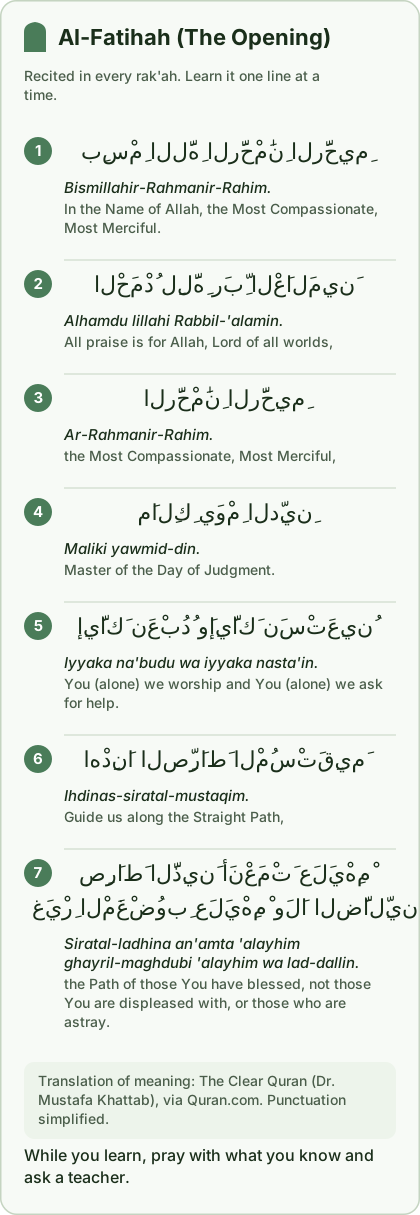
Each word with a transliteration and a translation of its meaning. The English helps you understand. The Arabic is the Quran. Read it right to left, one line a day.
Verse 1
Verse 2
Verse 3
Verse 4
Verse 5
Verse 6
Verse 7
English spelling uses the same letters for sounds that are different in Arabic. These are the ones English speakers most often find hard. Listen to a clear reciter for each one rather than relying on the spelling. A tajweed teacher can check the examples with you.
Every learner makes mistakes, and the Prophet said the one who recites with difficulty gets a double reward. In the Shafi'i school, a letter mistake spoils that word, so you say the word again once, correctly. The prayer itself is only invalid when a mistake changes the meaning and was made on purpose.
A Hanafi answer, citing Ibn Abidin, says that mixing up letters such as saad and seen by accident does not invalidate the prayer, and that a learner should keep making a reasonable effort. Ask a teacher for the Maliki and Hanbali details.
Repeating a word again and again, or restarting the whole prayer over one uncertain letter, is not required. That kind of doubt (waswasa) is something to let go of.
Watch on YouTube(opens in a new tab)
Nothing loads from YouTube until you press play. After that, the video plays in YouTube's privacy-enhanced player. If the video will not play or you are offline, use the Watch on YouTube link. More in our privacy policy.
Arabic 101 also sells live classes. This first lesson is free to watch.
Watch on YouTube(opens in a new tab)
Nothing loads from YouTube until you press play. After that, the video plays in YouTube's privacy-enhanced player. If the video will not play or you are offline, use the Watch on YouTube link. More in our privacy policy.
Press play on the Quran.com page to hear each verse. Mishary al-Afasy is a clear reciter to start with.
One verse of Al-Fatihah a day, under 10 minutes each, with the words broken down. Free, and you can read it without an account.
Short YouTube lessons on every phrase of the prayer. Episodes 11 to 18 go through Al-Fatihah verse by verse.
Costs nothing and needs no account for the free lessons. The site also sells paid one-to-one lessons, and the course author is not named.
Nothing here is saved and nothing is tracked. Pick one path, read slowly, and stop before you have had too much.
10 to 20 minutes
Start with short chapters that double as prayer practice. Read the meaning slowly, then listen once. Leave your pronunciation alone for now.
One quiet sitting
Read this when shame or fear is louder than hope. Sit with what these verses say about how near Allah is and how ready to forgive, before you add anything else.
Several short sittings
Read Surah Yusuf a few pages at a time. It runs as one continuous story: a family that turns on him, long patience, temptation, prison, and forgiveness at the end.
15 minutes
Tie your reading to your prayer. These passages put prayer in its place: remembrance, a request for guidance, and somewhere to go when you need patience.
10 minutes
Keep this one practical. After you read, ask what it would change about how you speak, how patient you are, and how you treat people today.
Print it and keep it somewhere you will see it. It does not save your progress or remind you of anything.
Day 1
Read the meaning of Al-Fatiha, then listen to it once. Carry the line about guidance with you through the day.
Day 2
Read Al-Ikhlas, Al-Falaq, and An-Nas. Notice what they say about Allah being one, and about asking for protection. Do not try to memorize them today.
Day 3
Read Quran 39:53 slowly. Then write one sentence, in your own words, about what Allah's mercy means for your situation.
Day 4
Read Quran 2:186 and 23:109. Then make a short dua in English, in your own words.
Day 5
Read Quran 20:14 and listen to Al-Fatiha again. Prayer is remembrance first. Getting it perfect comes later.
Day 6
Read Quran 2:153 and Al-'Asr. Pick one small thing today where you will be patient, or tell the truth when it would be easier not to.
Day 7
Go back to whichever passage stayed with you. If something confused you, write down the exact verse and take it to a teacher you trust.
Do not settle the question from a screenshot, a short clip, or an argument you stumbled into online.
Read the verses before and after it, then read a trusted explanation.
Write down the verse, what bothered you about it, and what you actually want cleared up.
Take it to a teacher, an imam, or a learning program that shows its sources.
Stick to sources that name their publisher and their teachers. Anonymous quote images and debate channels are a poor way to learn the Quran.
Read, listen, compare translations, and open reciter pages from a browser, so there is nothing to install.
A readable English translation of the meaning. Use it to understand, and keep the Arabic as the Quran itself.
Beginner classes and Quran help, written for people who are new to Islam.
A clear reciter to listen along with. Listen through first, then repeat one short piece.
The Quran references, translation notes, listening guidance, and handling notes on this page have been checked. Questions about your own recitation, purity, or tafsir belong with a qualified teacher.
Quran Foundation - Quran text and translation platform
Where the guide links Quran verses, so you can read the Arabic, compare an English translation of the meaning, and listen to the recitation.
Tanzil - Verified Quran text project
The reference for verified Arabic Quran text, and for keeping that text intact wherever it is quoted.
Dr. Mustafa Khattab / The Clear Quran - Quran translation of meaning
A beginner-friendly English translation, cited with the reminder that a translation carries the meaning and is not the Quran itself.
Quran.com - Quran text and translation reference
The source for the Al-Fatiha Arabic text, used in prayer recitation and in the dua for guidance. The English wording is a translation of the meaning.
Quran.com - Quran text and translation reference
Used as a short-surah example in the Salah Companion. The English wording is a translation of the meaning.
Quran.com - Quran text and translation reference
Used in the Quran starter path for the first sitting and the short-surah reading plan. The English wording is a translation of the meaning.
Quran.com - Quran text and translation reference
Used in the Quran starter path for the first sitting and the short-surah reading plan. The English wording is a translation of the meaning.
Quran.com - Quran text and translation reference
Used in the Quran starter path for the mercy and hope reading path. The English wording is a translation of the meaning.
Quran.com - Quran text and translation reference
Cited for the reminder that you can make dua to Allah directly. The example wording in the guide is not presented as a transmitted dua.
Quran.com - Quran text and translation reference
The source for the Quranic dua asking for forgiveness and mercy.
Quran.com - Quran text and translation reference
Used in the Quran starter path for the prophets and purpose reading path. The English wording is a translation of the meaning.
Quran.com - Quran text and translation reference
Used in the Quran starter path for the prayer and worship reading path. The English wording is a translation of the meaning.
Quran.com - Quran text and translation reference
Used in the Quran starter path for the character, patience, and worship reading paths. The English wording is a translation of the meaning.
Quran.com - Quran text and translation reference
Used as a short-surah example in the Salah Companion. The English wording is a translation of the meaning.
Quran.com - Quran recitation reference
Cited for Quran listening guidance, through an official reciter page on Quran.com.
New Muslim Academy - New Muslim Quran etiquette article
Cited for respectful handling of the Quran, with detailed purity questions left to a qualified local teacher.
New Muslim Academy - New Muslim education
Cited for beginner learning paths and for the practical support a new Muslim needs first.
SeekersGuidance - Qualified Islamic education
Cited where the guide stops short and tells you to ask a qualified scholar about your own situation.
Yaqeen Institute for Islamic Research - Islamic research and education
Cited for faith questions, doubts, spirituality, and beginner learning paths.
Quranic Arabic Corpus (University of Leeds; maintained by the Quran.com team) - Word-by-word reference
Every word of Al-Fatihah with Arabic, transliteration, an English gloss and grammar. Use it to check the word meanings on this site. GNU licence with terms of use; glosses are not copied here.
Quran.com (Quran.Foundation) - Learning plan
Free seven-day plan, one verse of Al-Fatihah a day, each lesson under 10 minutes, with a word-by-word breakdown. Lessons by Shaykh Hammad Fahim. Readable without an account; an account is optional for tracking progress.
Islamwise (new Muslim project with Green Lane Masjid) - Video (YouTube)
Phrase-by-phrase lessons on what is said in prayer, Al-Fatihah verse by verse (episodes 11 to 18), the tashahhud and salawat. Episode descriptions link to a presenter's personal playlist; use this Islamwise playlist. Partially verified. Linked only, not embedded. YouTube Standard Licence; no download or re-upload rights.
Islamwise (new Muslim project with Green Lane Masjid) - Video (YouTube)
Episode 12: teaches 'Alhamdu lillahi Rabbil-'alamin' and its meaning; episodes 11 to 18 cover Al-Fatihah the same way. Partially verified. Embedded through YouTube's privacy-enhanced player (youtube-nocookie.com) and loaded only after you press play. YouTube Standard Licence; the uploader allows embedding (checked 2026-09-23). No download or re-upload rights.
Madinah Arabic FZE (United Arab Emirates) - Online course
Free reading lessons for the Arabic letters, with grammar and vocabulary lists. No signup needed for the free courses; paid one-to-one lessons are also sold. The curriculum author is not named on the pages checked.
Arabic 101 (arabic101.org) - Video (YouTube)
The first seven letters, the four positions of each letter in a word, and reading first words. Arabic 101 also sells live lessons. Embedded through YouTube's privacy-enhanced player (youtube-nocookie.com) and loaded only after you press play. YouTube Standard Licence; the uploader allows embedding (checked 2026-09-23). No download or re-upload rights.