Step 1
Set your intention
In your heart, intend that this wudu is so you can pray. There is no formula to say out loud.
Worship learning tool
Awaiting scholar review
A simple guide to washing before prayer, made to be printed. Learn the essentials first, and take anything that depends on your own situation to a qualified teacher.
The water reaches everywhere it needs to.
You are washing for Allah, not out of panic.
You ask someone when a medical, work, or family situation makes this complicated.
Few people explain this, and it is awkward to ask in person. Muslims clean the private parts after using the toilet, and this cleaning (istinja) is its own step, separate from wudu. The Prophet (peace be upon him) used water for it (Sahih al-Bukhari 150), and a hadith treats carelessness about urine on the body as a serious matter (Sahih al-Bukhari 218).
If a disability or a medical device makes this hard, ask a local imam how to manage it.
Wudu is the partial washing you normally do before prayer. Quran 5:6 sets out which parts are washed and which are wiped, and beginner guides fill in the practical order.
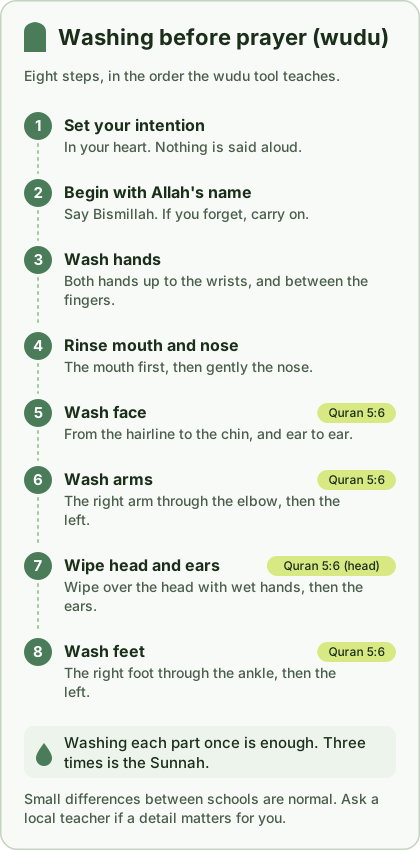
Step 1
In your heart, intend that this wudu is so you can pray. There is no formula to say out loud.
Step 2
Say Bismillah if you remember. If you forget, carry on. There is no need to start again.
Step 3
Wash both hands up to the wrists, making sure water reaches between the fingers.
Step 4
Rinse your mouth, then gently clean your nose. Use as much water as is comfortable and safe.
Step 5
Wash the face from the hairline to the chin and from ear to ear.
Step 6
Wash the right arm through the elbow, then the left arm through the elbow.
Step 7
With wet hands, wipe over your head. Most beginner guides also have you wipe your ears once.
Step 8
Wash the right foot through the ankle, then the left foot through the ankle.
This video has background music at the start and no spoken English. It shows one method; small details differ between schools.
Watch on YouTube(opens in a new tab)
Nothing loads from YouTube until you press play. After that, the video plays in YouTube's privacy-enhanced player. If the video will not play or you are offline, use the Watch on YouTube link. More in our privacy policy.
Ghusl is the full-body wash. Keep it modest and keep it simple: intend it, clean what needs cleaning, and make sure water reaches your whole body.
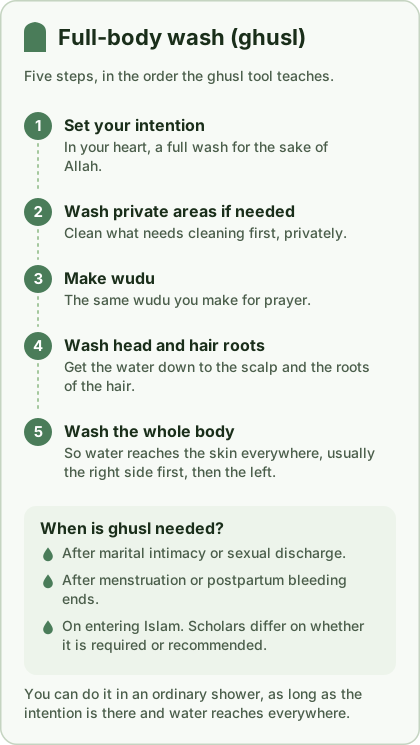
Step 1
In your heart, intend a full-body wash for the sake of Allah. The minimum is that water reaches your whole body, including the roots of your hair.
Step 2
Clean whatever needs cleaning first, privately, before you go on.
Step 3
Make wudu as part of the ghusl. If your wudu breaks afterwards, do it again before you pray.
Step 4
Get the water down to your scalp and hair roots as best you can. A woman with tightly braided hair does not have to undo the braids: pour water over the head three times so it reaches the roots (Sahih Muslim 330a, where one narration mentions the wash after menstruation too). For extensions, locs, wigs, glued hair or a medical dressing, ask someone qualified.
Step 5
Wash your whole body so water reaches the skin everywhere, usually the right side first and then the left.
Shows a simple way and the fuller Sunnah way. Schools differ on whether rinsing the mouth and nose is required in ghusl.
Watch on YouTube(opens in a new tab)
Nothing loads from YouTube until you press play. After that, the video plays in YouTube's privacy-enhanced player. If the video will not play or you are offline, use the Watch on YouTube link. More in our privacy policy.
No single source we checked compares all four schools side by side. If one of these comes up often for you, ask a local teacher which view you follow.
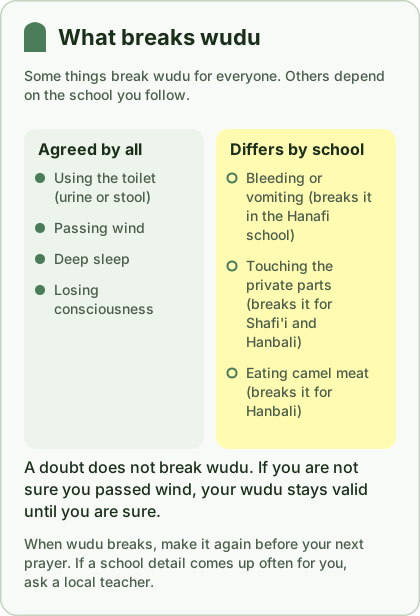
When you cannot use water, because there is none, or because you are ill or injured and water would harm you, there is a dry alternative called tayammum. The Quran allows it for people who are ill, travelling or cannot find water.
One method uses a single strike and wipes the hands to the wrists, as in Sahih al-Bukhari 338. The Hanafi method uses two strikes: one for the face, and a second to wipe both arms including the elbows.
Tayammum ends when you find water you can use, and with anything that breaks wudu or calls for ghusl.
If an illness or injury keeps you away from water for a while, ask a local teacher how to manage it day to day.
Jump to a part
Chapter labels come from YouTube and may not show for everyone, but the jump links still work.
Watch on YouTube(opens in a new tab)
Nothing loads from YouTube until you press play. After that, the video plays in YouTube's privacy-enhanced player. If the video will not play or you are offline, use the Watch on YouTube link. More in our privacy policy.
Some full-body washes are recommended rather than required. The best known are the wash before Friday prayer and the wash on the morning of each Eid.
Your body, your clothes and the spot you pray on should be free of impurity such as urine, stool or blood. Wash it until the substance, its colour and its smell are gone as far as you reasonably can.
Some conditions keep breaking wudu: constant wind with IBS, leaking urine, bleeding outside the period, or a stoma or catheter. Keep praying. A woman whose bleeding would not stop was told to keep praying and to make wudu for every prayer (Sahih al-Bukhari 228).
Describe your pattern to an imam once and get a clear answer for your situation. You are not being asked to make wudu again every few minutes.
Many scholars allow wiping over leather footwear (khuffs) or suitable socks, with conditions. You must have put them on after a full wudu, and the permission lasts one day and night at home, or three days and nights when travelling. For ghusl you still wash your feet. The schools differ on which socks count. In the Hanafi answer we link, they must be sturdy enough to walk about 3.5 miles (5.5 km) in without tearing, and water must not soak through, so ordinary dress socks usually do not qualify while hiking socks often do. Other teaching allows ordinary socks. Ask your local imam which view your community follows.
Regular nail polish stops water reaching your nails, so wudu made over it does not count. If you made wudu first and then put the polish on, you can pray with that wudu. Take the polish off before your next wudu. If you are unsure about a particular product, ask a local teacher.
The Hanafi answer we link says: wash the injured part if you can; if you cannot, wipe it with a wet hand; if that would harm you, wipe over most of the bandage; and if even that would cause harm, leave that part out. The Shafi'i school also wipes over the cast but adds tayammum for that limb, and in some cases the prayer is repeated later. Past experience, clear signs or a trustworthy doctor's advice help you judge harm. Please ask a local imam about your own situation.
In the Hanafi answer we link, you must wipe at least a quarter of the head itself, and wiping over the scarf does not count. One practical way is to loosen the front of the scarf in a private stall and slide a wet hand underneath. The Hanbali school allows wiping over a scarf that is wrapped under the chin, as long as you put it on while in wudu, for one day and night (three when travelling). A SeekersGuidance answer says you may follow the Hanbali view for this, provided your wudu and your prayer are both valid in that school. Making wudu at home and keeping it, and wiping over suitable socks for your feet, also cut down on washing at work. Ask your teacher which option suits you.
A hadith in Sahih Muslim (258) says trimming the moustache, cutting the nails and removing underarm and pubic hair should not be left for more than forty nights. A weekly grooming day, often Friday, keeps you well inside that. The modesty topic covers these grooming habits (fitrah) and the school differences on the beard.
Do the steps once, with attention, then stop. Repeating out of anxiety turns purification into something that wears you down.
Nothing has gone wrong. Learn the essentials first, then ask a teacher which parts are required in your school of law.
Ask a qualified person about the concessions, such as wiping over a bandage, or tayammum. Islam does not ask you to make your health worse.
Pick one reliable beginner method and learn it properly. Small differences between teachers do not mean your worship is broken.
Wanting to get wudu and prayer right is a good sign. For some people that care turns into doubt that will not let go: washing an arm five times, restarting a prayer, or thoughts about Allah that you hate and cannot stop. This is often called waswas (whispering). The Prophet gave clear guidance for it. When it takes over a person's day, it can also be a form of obsessive-compulsive disorder (OCD), which is treatable.
The Prophet told a man who thought he had passed wind during prayer not to leave it unless he heard a sound or noticed a smell (Sahih al-Bukhari 137). Scholars take a general rule from this: certainty is not removed by a doubt. If you made wudu and are not sure whether it broke, it has not broken.
Some companions told the Prophet they had thoughts too terrible to say out loud. He said, "That is the faith manifest" (Sahih Muslim 132a). Another man said he would rather be burned to charcoal than speak his thoughts, and the Prophet praised Allah, who had reduced the devil's plot to whispering (Sunan Abi Dawud 5112, graded sahih by al-Albani).
The Prophet said Allah has overlooked the bad thoughts that come into people's minds, as long as they do not act on them or say them (Sahih al-Bukhari 5269). Dr. Jibran Khokhar, a Canadian researcher writing for the Yaqeen Institute, cites this hadith for unwanted intrusive thoughts.
The rule that a doubt does not remove certainty is taught across the schools. The details differ, for example for a doubt during wudu compared with after it, or a doubt about how many units (rak'ahs) you prayed. The answer we link is from the Hanafi school, so ask your teacher for your own school's details.
If you lose count in prayer: the prostration of forgetfulness (sujud al-sahw)CAMH, Canada's largest mental health teaching hospital, says OCD affects about 1 in 40 adults. Common obsessions include repeated doubting and fear of having blasphemous thoughts. Common compulsions include excessive washing, checking and mental rituals such as praying. Treatment is usually cognitive behavioural therapy (CBT), often with medication.
Najwa Awad writes that waswas "is not a Muslim disease" but a religious presentation of OCD in Muslims. She says a form of CBT called exposure and response prevention (ERP) has been shown to be quite effective, and that an imam and a clinician can work together. Dr. Khokhar writes that seeing a qualified professional is not a sign of weak faith but a means of healing.
These signs are a rough guide, not a diagnosis, and a clinician is the right person to judge. CAMH describes OCD as obsessions and compulsions that get in the way of daily life.
Mental health support and where to startThis is a beginner tool. Some purification details differ between schools of law, and your own situation is worth going over with a qualified local imam or scholar.
Quran Foundation - Quran text and translation platform
Where the guide links Quran verses, so you can read the Arabic, compare an English translation of the meaning, and listen to the recitation.
New Muslim Guide - Purification guide
Cited for the beginner sequence of wudu and an overview of ghusl, with the finer details left to a qualified teacher.
New Muslim Guide - Purification guide
Cited for the difference between minor and major ritual impurity, without turning the guide into a detailed fiqh manual.
SeekersGuidance - Qualified Islamic education
Cited where the guide stops short and tells you to ask a qualified scholar about your own situation.
Green Lane Masjid and Community Centre (Birmingham, UK) - Video (YouTube)
A visual walk-through of wudu with no spoken English. Partially verified: the content description rests on auto-captions. The intro has background music according to the captions. Embedded through YouTube's privacy-enhanced player (youtube-nocookie.com) and loaded only after you press play. YouTube Standard Licence; the uploader allows embedding (checked 2026-09-23). No download or re-upload rights.
Green Lane Masjid and Community Centre (Birmingham, UK) - Video (YouTube)
When ghusl (the full-body wash) is needed, a simple method and the fuller Sunnah method. YouTube chapters: 0:00 introduction, 0:10 reasons, 0:45 simple method, 1:19 Prophetic way, 2:47 conclusion. Schools differ on whether rinsing the mouth and nose is required in ghusl. Embedded through YouTube's privacy-enhanced player (youtube-nocookie.com) and loaded only after you press play. YouTube Standard Licence; the uploader allows embedding (checked 2026-09-23). No download or re-upload rights.
Sunnah.com - Hadith reference
The prayer of someone who passes urine, stool or wind is not accepted until they make wudu. In Sahih al-Bukhari.
Sunnah.com - Hadith reference
The one who sleeps should make wudu. Graded Hasan (al-Albani) on Sunnah.com.
Sunnah.com - Hadith reference
Someone who imagines they passed wind in prayer should not leave the prayer unless they hear a sound or notice a smell. In Sahih al-Bukhari.
SeekersGuidance - Scholarly answer
Shaykh Faraz Rabbani, 11 February 2024. The Hanafi list: anything leaving the front or back passage, a mouthful of vomit, blood from the mouth that equals or outweighs the saliva, sleep when not firmly seated, loss of consciousness, and an adult laughing out loud in a prayer with bowing and prostration. Link only.
The Islamic Foundation of Ireland - Beginner booklet
Imam Yahya M. Al-Hussein, preface dated 1999. Rak'ah counts and where the tashahhud comes in each prayer (Fajr after the 2nd; Dhuhr, Asr and Isha after the 2nd and 4th; Maghrib after the 2nd and 3rd). Its list of what breaks wudu includes touching the private parts and excludes bleeding and vomiting, which is not the Hanafi view. Link only; no licence stated.
Sunnah.com - Hadith reference
Qays ibn Asim became Muslim and the Prophet told him to wash his whole body with water and lote-tree leaves. Graded Sahih (al-Albani) on Sunnah.com.
MuslimMatters.org (Shaykh Abdullah Hasan) - Scholarly answer
13 February 2017. Three positions: required in all cases (Maliki and Hanbali), not required (some Hanafi scholars), and the relied-upon Hanafi and Shafi'i view: required if the person was in a state needing ghusl, otherwise recommended. An online magazine article, not a fatwa body. Link only.
IslamWeb (Fatwa Centre) - Scholarly answer
3 October 2010. Ghusl is not a condition of a valid conversion; the two testimonies with conviction are enough. It calls ghusl on entering Islam recommended in the predominant view. Link only.
Quran.com - Quran reference
Do not approach prayer in a state of full impurity until you have bathed; if you are ill, travelling or find no water, use clean earth.
Quran.com - Quran reference
Wash your faces and your hands up to the elbows, wipe your heads, and wash your feet to the ankles; bathe after full impurity; use clean earth if ill, travelling or without water.
Sunnah.com - Hadith reference
Ammar's report: strike the earth with the hands, blow into them, then wipe the face and hands. In Sahih al-Bukhari.
NewMuslims.com - Lesson
Imam Mufti, 2012. When tayammum is allowed, the one-strike method wiping the face and hands to the wrists, valid surfaces, and what ends it (finding water, or anything that breaks wudu or calls for ghusl). Link only.
SeekersGuidance - Scholarly answer
Ustadh Tabraze Azam, checked by Shaykh Faraz Rabbani, 15 December 2013. The Hanafi method: two strikes, the face, then both arms including the elbows. Link only.
Green Lane Masjid and Community Centre (Birmingham, UK) - Video (YouTube)
Steps of tayammum (dry purification), when it is allowed, what ends it and valid materials. Schools differ on one or two strikes and how far the arms are wiped. Embedded through YouTube's privacy-enhanced player (youtube-nocookie.com) and loaded only after you press play. YouTube Standard Licence; the uploader allows embedding (checked 2026-09-23). No download or re-upload rights.
SeekersGuidance - Scholarly answer
Ustadh Tabraze Azam, checked by Shaykh Faraz Rabbani, 30 October 2014. Footwear can be wiped over if you could walk about 3.5 miles in it without it tearing and water does not soak through; ordinary dress socks usually fail, hiking socks often qualify. Link only.
SeekersGuidance - Scholarly answer
Ustadha Shaista Maqbool, checked by Shaykh Faraz Rabbani, 11 July 2014. Nail polish stops water reaching the nail, so wudu over it is not valid; prayers with a wudu made before applying it are valid; remove it before the next wudu. Link only.
SeekersGuidance - Scholarly answer
Ustadh Tabraze Azam, checked by Shaykh Faraz Rabbani, 13 May 2016. Wash the area if you can; if not, wipe it; if not, wipe most of the bandage; if even that would cause harm, leave it. Harm is judged by past experience, clear signs, or a skilled, trustworthy Muslim doctor. Link only.
SeekersGuidance - Scholarly answer
Ustadh Shuaib Ally, 18 February 2015. Wash what you can, wipe the cast with water, and do tayammum in place of the covered part; whether prayers are repeated depends on where the cast is and whether it was put on in a state of purity. Link only.
NewMuslims.com - Lesson
Imam Mufti, 2011. When ghusl is needed; the minimum is that water reaches the whole body; the fuller Sunnah method step by step. Link only.
Sunnah.com - Hadith reference
Sahih Muslim 132a, in Sahih Muslim (sahih). Cited for: companions troubled by thoughts too grave to speak were told, 'That is the faith manifest'; such thoughts are a sign of faith, not a loss of it (Book of Faith, chapter on waswasah).
Sunnah.com - Hadith reference
Sunan Abi Dawud 5112 (Book 43, Hadith 340), graded Sahih by al-Albani on Sunnah.com. A man said he would rather be burned to charcoal than speak his thoughts; the Prophet said 'Allahu akbar' and praised Allah who reduced the devil's plot to whispering.
Sunnah.com - Hadith reference
Sahih al-Bukhari 5269 (Book 68, Hadith 19): Allah has overlooked the evil thoughts that occur to people's minds as long as they are not acted on or spoken. It sits in the Book of Divorce. Cited only for unwanted intrusive thoughts, as Khokhar does, and never for thoughts of suicide.
SeekersGuidance - Scholar answer (Hanafi)
Shaykh Faraz Rabbani, 17 September 2010. A Hanafi answer giving five principles: certainty is not lifted by a doubt, certainty is only lifted by certainty, doubts carry no legal weight, and following baseless misgivings is blameworthy. The maxim is shared across the schools, but this answer speaks for the Hanafi school.
Yaqeen Institute - Islamic research and education
By Dr. Jibran Khokhar, Yaqeen Senior Fellow and Canada Research Chair at Western University (a researcher, not a clinician), published 13 August 2026. Says intrusive thoughts are not sins (citing Muslim 132a, Bukhari 5269 and Muslim 127), advises dismissing whispers rather than analysing them, seeking refuge in Allah and practising response prevention, and says seeking help from a qualified mental health professional 'is not a sign of weak faith but a means of healing.'
Yaqeen Institute - Islamic research and education
By Najwa Awad, psychotherapist, published 19 July 2017, updated 22 July 2024. Says waswasah 'is not a Muslim disease' but a religious presentation of OCD in Muslims, that exposure and response prevention (ERP) has been shown to be quite effective, that imams and clinicians should work together, and that imams should teach the principle that doubt does not negate certainty rather than keep answering the same question, since reassurance feeds the compulsion.
Centre for Addiction and Mental Health (CAMH) - Public health information
CAMH, Toronto. Supports: common OCD obsessions include 'preoccupation with religious images and thoughts or fear of having blasphemous thoughts' and repeated doubting; compulsions include mental rituals such as praying; treatment ideally combines counselling (most often cognitive behavioural therapy) with medication. Review date not shown on the page.
Sunnah.com - Hadith reference
Sahih al-Bukhari 150 (Anas bin Malik), in Sahih al-Bukhari: a container of water was taken for the Prophet when he went to relieve himself, so he could wash. Supports the glossary entry for istinja.
Sunnah.com - Hadith reference
Sahih al-Bukhari 218 (Ibn Abbas): of two people punished in their graves, one never kept himself clean of his urine. Sahih. Used gently for why cleaning after the toilet matters.
Sunnah.com - Hadith reference
Sahih Muslim 262a (Salman): the Prophet forbade facing the qibla when relieving oneself, cleaning with the right hand, cleaning with fewer than three stones, and using dung or bone. Sahih.
SeekersGuidance - Scholar answer
Shaykh Faraz Rabbani, 18 October 2011. Tissue then water is best; wiping alone fulfils the sunnah; if filth goes beyond the exit and its immediate surround, washing is required.
SeekersGuidance - Scholar answer
Shaykh Yusuf Weltch, checked by Shaykh Faraz Rabbani, 27 July 2022. Toilet paper alone fulfils the basic sunnah when the impurity has not spread beyond the exit; washing is preferable.
SeekersGuidance - Scholar answer
Mawlana Ilyas Patel, 5 September 2023. After cleaning properly, doubts should be ignored; acting on baseless doubts is blameworthy; points to reading on OCD and misgivings (waswasa).
Sunnah.com - Hadith reference
Sahih al-Bukhari 877 (Ibn Umar): anyone attending the Friday prayer should make the full-body wash (ghusl). Sahih.
Sunnah.com - Hadith reference
Sahih al-Bukhari 879 (Abu Sa'id): the Friday full-body wash (ghusl) is described as due from every male who has reached puberty. Sahih. The strong wording is read differently by scholars.
Sunnah.com - Hadith reference
Sunan Abi Dawud 354 (Samurah): whoever makes wudu on Friday has done well, and whoever bathes, bathing is better. Graded Hasan by al-Albani.
SeekersGuidance - Scholar answer
Salman Younas, checked by Shaykh Faraz Rabbani, 15 May 2010. The relied-upon view: the Friday ghusl is a sunnah for the prayer; in need, such as for those who work on Fridays, one may follow the view that it is a sunnah for the day.
SeekersGuidance - Scholar answer
Ustadha Naielah Ackbarali, 12 May 2021. Ghusl and best clothes among the Eid sunnahs; eat before the Eid al-Fitr prayer and delay eating on Eid al-Adha; three extra takbirs with raised hands in each rak'ah (in the second after the recitation); two short sermons after the prayer; wajib on sane, adult, resident, healthy men.
Sunnah.com - Hadith reference
Sahih Muslim 330a (Umm Salama): she need not undo closely plaited hair for the full-body wash; pouring three handfuls of water over the head is enough. Sahih. Muslim 330b adds that one narration mentions the bath after menstruation as well as after intercourse.
Quran.com - Quran reference
'And purify your garments' (Al-Muddaththir 74:4). The basis for keeping clothes clean for worship.
SeekersGuidance - Scholar answer
Shaykh Irshaad Sedick, 24 September 2023. Shafi'i: heavy filth (dog, pig) is washed seven times, one with earth; light filth (urine of a milk-fed boy under two) is sprinkled; other filth is washed until its substance, colour and smell are gone where feasible.
Sunnah.com - Hadith reference
Sahih al-Bukhari 228 (Aisha, about Fatimah bint Abi Hubaish): bleeding outside the period is not menstruation; keep praying and make wudu for every prayer. Sahih.
SeekersGuidance - Scholar answer
Supports: Hanafi excused person: wudu lasts until the prayer time exits.
SeekersGuidance - Scholar answer
Ustadh Tabraze Azam, 31 October 2015. Wiping a quarter of the head is obligatory; wiping over the headscarf does not count.
SeekersGuidance - Scholar answer
Mawlana Ilyas Patel, 21 February 2023. Hanbali: a woman may wipe over a scarf wrapped under the chin, put on after wudu, for one day (three for travellers); one may follow the Hanbali school for this if both the wudu and the prayer are valid in that school.
Sunnah.com - Hadith reference
In Sahih Muslim. Cited for: a time limit was set for trimming the moustache, cutting the nails, removing underarm hair and shaving pubic hair, that they not be left for more than forty nights.