Le Coran en arabe
Le texte arabe révélé. Quand cette page renvoie à un verset, c'est l'arabe qui est le Coran. Tout le reste sert à le comprendre.
Parcours pour débutants
En attente de révision savante
Commencez à lire et à écouter sans en faire un projet où l'on peut échouer. De courts passages, des traductions honnêtes, une question à la fois.
Un petit passage lu avec attention vaut mieux qu'un long passage lu sous pression.
La traduction transmet le sens. Le texte arabe, lui, est le Coran.
Quand un verset vous trouble ou vous inquiète, apportez-le à un enseignant de confiance.
Le texte arabe est le texte révélé. Une traduction vous donne accès au sens, mais elle reste le rendu d'une personne. Une partie de ce que contient l'arabe ne passe donc pas.
Le texte arabe révélé. Quand cette page renvoie à un verset, c'est l'arabe qui est le Coran. Tout le reste sert à le comprendre.
Une version dans une autre langue, comme le français, qui transmet le sens. Elle vous aide à comprendre, mais elle n'est pas le Coran lui-même.
Les sons de l'arabe écrits en lettres latines. C'est pratique pour s'exercer, mais votre oreille apprendra davantage avec un enseignant ou un récitateur fiable.
L'explication savante de ce que veut dire un verset, du moment où il a été révélé et de ce qu'il vous demande. Tournez-vous vers elle quand un verset vous semble difficile.
Vous n'avez pas besoin d'apprendre toute la langue pour prier. Commencez par Al-Fatihah, le chapitre récité dans chaque unité de prière (rak'ah), et apprenez ses mots et leur sens. Continuez à prier avec ce que vous savez pendant ce temps.
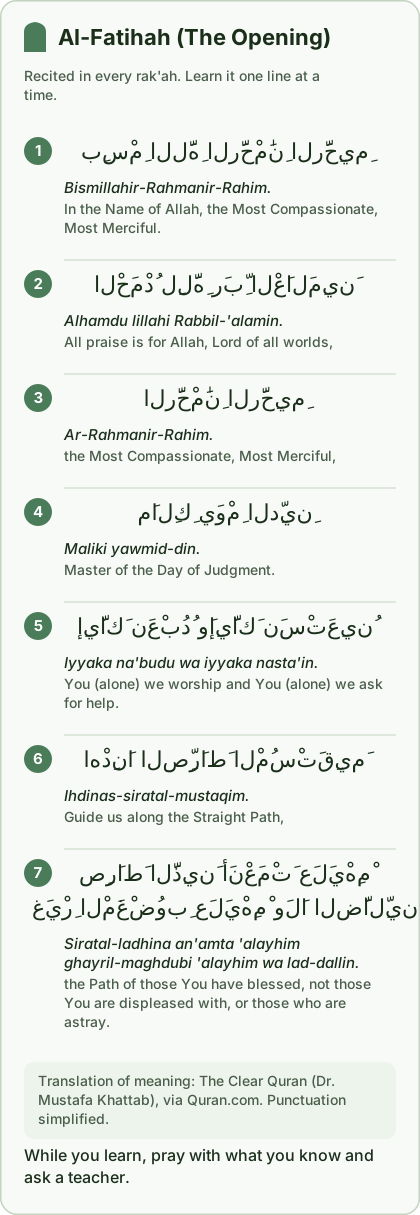
Chaque mot avec sa translittération et une traduction de son sens. Le français vous aide à comprendre. Le texte arabe est le Coran. Lisez-le de droite à gauche, une ligne par jour.
Verset 1
Verset 2
Verset 3
Verset 4
Verset 5
Verset 6
Verset 7
L'écriture en lettres latines utilise les mêmes lettres pour des sons qui sont différents en arabe. Voici ceux que les francophones trouvent le plus souvent difficiles. Écoutez un récitateur clair pour chacun plutôt que de vous fier à l'orthographe. Un enseignant de tajweed peut vérifier les exemples avec vous.
Tous les apprenants font des erreurs, et le Prophète a dit que celui qui récite avec difficulté reçoit une double récompense. Dans l'école chaféite, une erreur de lettre gâte ce mot : vous redites donc le mot une fois, correctement. La prière elle-même n'est invalide que si une erreur change le sens et a été faite volontairement.
Une réponse hanafite, citant Ibn Abidin, dit que confondre par accident des lettres comme sad et sin n'invalide pas la prière, et qu'un apprenant devrait continuer de faire un effort raisonnable. Demandez à un enseignant les détails malikites et hanbalites.
Répéter un mot encore et encore, ou recommencer toute la prière pour une seule lettre incertaine, n'est pas exigé. Ce genre de doute (waswasa) est à laisser passer.
Regarder sur YouTube(s'ouvre dans un nouvel onglet)
Rien ne se charge depuis YouTube avant que vous appuyiez sur lecture. Ensuite, la vidéo passe dans le lecteur YouTube en mode de confidentialité avancée. Si la vidéo ne démarre pas ou si vous êtes hors ligne, utilisez le lien Regarder sur YouTube. Pour en savoir plus, consultez notre politique de confidentialité.
Arabic 101 vend aussi des cours en direct. Cette première leçon est gratuite.
Regarder sur YouTube(s'ouvre dans un nouvel onglet)
Rien ne se charge depuis YouTube avant que vous appuyiez sur lecture. Ensuite, la vidéo passe dans le lecteur YouTube en mode de confidentialité avancée. Si la vidéo ne démarre pas ou si vous êtes hors ligne, utilisez le lien Regarder sur YouTube. Pour en savoir plus, consultez notre politique de confidentialité.
Appuyez sur lecture sur la page de Quran.com pour entendre chaque verset. Mishary al-Afasy est un récitateur clair pour commencer.
Un verset d'Al-Fatihah par jour, moins de 10 minutes chaque fois, mot par mot. C'est gratuit, et vous pouvez le lire sans compte.
De courtes leçons sur YouTube pour chaque formule de la prière. Les épisodes 11 à 18 passent en revue Al-Fatihah verset par verset.
Les leçons gratuites ne coûtent rien et ne demandent aucun compte. Le site vend aussi des cours particuliers payants, et l'auteur du cours n'est pas nommé.
Rien n'est enregistré et rien n'est suivi ici. Choisissez un parcours, lisez lentement et arrêtez-vous avant d'en avoir trop.
10 à 20 minutes
Commencez par de courts chapitres qui servent aussi à vous exercer pour la prière. Lisez lentement le sens, puis écoutez une fois. Ne vous souciez pas encore de votre prononciation.
Une séance au calme
Lisez ceci quand la honte ou la peur parlent plus fort que l'espoir. Prenez le temps de méditer ce que ces versets disent de la proximité d'Allah et de Sa disposition à pardonner, avant d'ajouter quoi que ce soit.
Plusieurs courtes séances
Lisez la sourate Yusuf quelques pages à la fois. C'est un seul récit continu : une famille qui se retourne contre lui, une longue patience, la tentation, la prison, et le pardon à la fin.
Un quart d'heure
Reliez votre lecture à votre prière. Ces passages montrent la place de la prière : un rappel d'Allah, une demande de guidance et un refuge quand vous avez besoin de patience.
Dix minutes
Restez concret avec celle-ci. Après votre lecture, demandez-vous ce qu'elle changerait aujourd'hui à votre façon de parler, à votre patience et à votre façon de traiter les gens.
Imprimez-la et gardez-la là où vous la verrez. Elle n'enregistre pas vos progrès et ne vous rappelle rien.
Jour 1
Lisez le sens d'Al-Fatiha, puis écoutez-la une fois. Gardez avec vous toute la journée le verset sur la guidance.
Jour 2
Lisez Al-Ikhlas, Al-Falaq et An-Nas. Remarquez ce qu'elles disent de l'unicité d'Allah et de la demande de protection. N'essayez pas de les mémoriser aujourd'hui.
Jour 3
Lisez lentement Coran 39:53. Écrivez ensuite une phrase, avec vos propres mots, sur ce que la miséricorde d'Allah signifie pour votre situation.
Jour 4
Lisez Coran 2:186 et 23:109. Faites ensuite une courte invocation (dua) en français, avec vos propres mots.
Jour 5
Lisez Coran 20:14 et écoutez de nouveau Al-Fatiha. La prière est d'abord un rappel d'Allah. La perfection viendra plus tard.
Jour 6
Lisez Coran 2:153 et Al-'Asr. Choisissez aujourd'hui une petite occasion d'être patient, ou de dire la vérité quand il serait plus facile de ne pas le faire.
Jour 7
Revenez au passage qui vous a le plus marqué. Si quelque chose vous a semblé confus, notez le verset exact et soumettez-le à un enseignant en qui vous avez confiance.
Ne tranchez pas la question à partir d'une capture d'écran, d'un court extrait vidéo ou d'une dispute croisée par hasard en ligne.
Lisez les versets avant et après, puis une explication fiable.
Notez le verset, ce qui vous a dérangé et ce que vous voulez vraiment éclaircir.
Apportez-la à un enseignant, un imam ou un programme d'études qui cite ses sources.
Tenez-vous-en aux sources qui nomment leur éditeur et leurs enseignants. Les images de citations anonymes et les chaînes de débats sont un mauvais moyen d'apprendre le Coran.
Lisez, écoutez, comparez les traductions et ouvrez les pages des récitateurs dans un navigateur, sans rien installer.
Une traduction anglaise du sens, facile à lire. Servez-vous-en pour comprendre, en gardant à l'esprit que le Coran lui-même est le texte arabe.
Des cours pour débutants et de l'aide pour le Coran, conçus pour les personnes qui découvrent l'islam.
Un récitateur clair à écouter en suivant le texte. Écoutez d'abord en entier, puis répétez un court passage.
Les références coraniques, les notes sur les traductions, les conseils d'écoute et les notes sur la manière de traiter le Coran ont été vérifiés. Les questions sur votre propre récitation, la pureté ou l'exégèse (tafsir) relèvent d'un enseignant qualifié.
Quran Foundation - Plateforme de texte et de traduction du Coran
Le site vers lequel le guide renvoie pour les versets du Coran : vous pouvez y lire l'arabe, comparer une traduction anglaise du sens et écouter la récitation.
Tanzil - Projet de texte vérifié du Coran
La référence pour le texte arabe vérifié du Coran, et pour garder ce texte intact partout où il est cité.
Dr. Mustafa Khattab / The Clear Quran - Traduction du sens du Coran
Une traduction anglaise accessible aux débutants, citée avec ce rappel : une traduction transmet le sens, elle n'est pas le Coran lui-même.
Quran.com - Référence de texte et de traduction du Coran
La source du texte arabe d'Al-Fatiha, récité dans la prière et dans l'invocation pour demander la guidée. Le texte anglais est une traduction du sens.
Quran.com - Référence de texte et de traduction du Coran
Donnée comme exemple de courte sourate dans le Salah Companion. Le texte anglais est une traduction du sens.
Quran.com - Référence de texte et de traduction du Coran
Utilisée dans le parcours de découverte du Coran pour la première séance et le plan de lecture des courtes sourates. Le texte anglais est une traduction du sens.
Quran.com - Référence de texte et de traduction du Coran
Utilisée dans le parcours de découverte du Coran pour la première séance et le plan de lecture des courtes sourates. Le texte anglais est une traduction du sens.
Quran.com - Référence de texte et de traduction du Coran
Utilisé dans le parcours de découverte du Coran pour le parcours de lecture sur la miséricorde et l'espoir. Le texte anglais est une traduction du sens.
Quran.com - Référence de texte et de traduction du Coran
Cité pour rappeler que vous pouvez invoquer Allah directement. Les exemples de formulation du guide ne sont pas présentés comme une invocation transmise.
Quran.com - Référence de texte et de traduction du Coran
La source de l'invocation coranique qui demande le pardon et la miséricorde.
Quran.com - Référence de texte et de traduction du Coran
Utilisée dans le parcours de découverte du Coran pour le parcours de lecture sur les prophètes et le sens de la vie. Le texte anglais est une traduction du sens.
Quran.com - Référence de texte et de traduction du Coran
Utilisé dans le parcours de découverte du Coran pour le parcours de lecture sur la prière et le culte. Le texte anglais est une traduction du sens.
Quran.com - Référence de texte et de traduction du Coran
Utilisé dans le parcours de découverte du Coran pour les parcours de lecture sur le caractère, la patience et le culte. Le texte anglais est une traduction du sens.
Quran.com - Référence de texte et de traduction du Coran
Donnée comme exemple de courte sourate dans le Salah Companion. Le texte anglais est une traduction du sens.
Quran.com - Référence de récitation du Coran
Cité pour les conseils d'écoute du Coran, au moyen d'une page officielle du récitateur sur Quran.com.
New Muslim Academy - Article sur les bonnes manières envers le Coran pour nouveaux musulmans
Cité pour la manière respectueuse de manipuler le Coran. Les questions détaillées de pureté sont laissées à un enseignant qualifié de votre région.
New Muslim Academy - Enseignement pour nouveaux musulmans
Cité pour les parcours d'apprentissage des débutants et pour le soutien pratique dont un nouveau musulman a besoin en premier.
SeekersGuidance - Enseignement islamique qualifié
Cité là où le guide s'arrête et vous invite à demander à un savant qualifié ce qui s'applique à votre situation.
Yaqeen Institute for Islamic Research - Recherche et enseignement islamiques
Cité pour les questions de foi, les doutes, la spiritualité et les parcours d'apprentissage pour débutants.
Quranic Arabic Corpus (University of Leeds; maintained by the Quran.com team) - Référence mot à mot
Chaque mot d'Al-Fatihah avec l'arabe, la translittération, une glose anglaise et la grammaire. Servez-vous-en pour vérifier le sens des mots sur ce site. Licence GNU avec conditions d'utilisation; les gloses ne sont pas reprises ici.
Quran.com (Quran.Foundation) - Plan d'apprentissage
Un plan gratuit de sept jours, un verset d'Al-Fatihah par jour, chaque leçon en moins de 10 minutes, avec une analyse mot à mot. Leçons de Cheikh Hammad Fahim. Lisible sans compte; un compte est facultatif pour suivre vos progrès.
Islamwise (new Muslim project with Green Lane Masjid) - Vidéo (YouTube)
Des leçons formule par formule sur ce que l'on dit dans la prière, Al-Fatihah verset par verset (épisodes 11 à 18), le tashahhud et les salawat. Les descriptions des épisodes renvoient à une liste de lecture personnelle d'un présentateur; utilisez plutôt cette liste de lecture d'Islamwise. Vérification partielle. Lien seulement, sans intégration. Licence : YouTube Standard Licence; aucun droit de téléchargement ni de republication.
Islamwise (new Muslim project with Green Lane Masjid) - Vidéo (YouTube)
Épisode 12 : enseigne « Alhamdu lillahi Rabbil-'alamin » et son sens; les épisodes 11 à 18 présentent Al-Fatihah de la même manière. Vérification partielle. Intégrée au moyen du lecteur YouTube à confidentialité renforcée (youtube-nocookie.com) et chargée seulement quand vous appuyez sur lecture. Licence : YouTube Standard Licence; la personne qui l'a publiée autorise l'intégration (vérifié le 2026-09-23). Aucun droit de téléchargement ni de republication.
Madinah Arabic FZE (United Arab Emirates) - Cours en ligne
Des leçons de lecture gratuites pour les lettres arabes, avec des listes de grammaire et de vocabulaire. Aucune inscription n'est nécessaire pour les cours gratuits; des leçons individuelles payantes sont aussi vendues. L'auteur du programme n'est pas nommé sur les pages vérifiées.
Arabic 101 (arabic101.org) - Vidéo (YouTube)
Les sept premières lettres, les quatre positions de chaque lettre dans un mot, et la lecture des premiers mots. Arabic 101 vend aussi des leçons en direct. Intégrée au moyen du lecteur YouTube à confidentialité renforcée (youtube-nocookie.com) et chargée seulement quand vous appuyez sur lecture. Licence : YouTube Standard Licence; la personne qui l'a publiée autorise l'intégration (vérifié le 2026-09-23). Aucun droit de téléchargement ni de republication.