The five pillars of Islam
The five practices that hold up a Muslim's life, where each one comes from, and which ones apply to you now as a new Muslim.
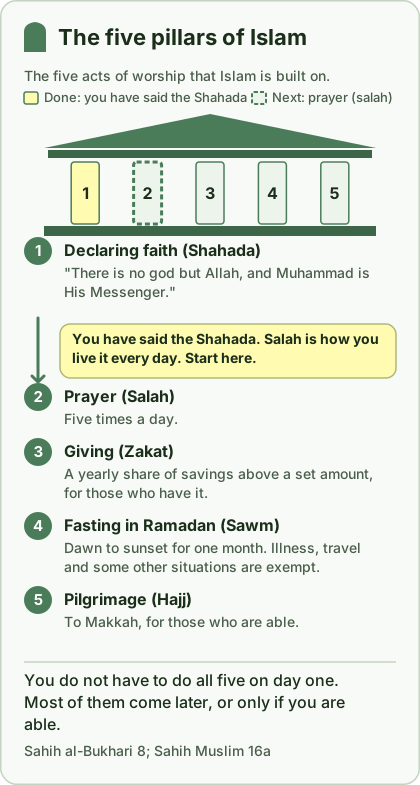
What the five pillars are
The Prophet Muhammad (peace be upon him) said that Islam is built on five: testifying that there is no god but Allah and that Muhammad is the Messenger of Allah, establishing prayer, paying zakat, performing Hajj, and fasting in Ramadan. That is a translation of the meaning of the hadith in Sahih al-Bukhari 8. Sahih Muslim 16a reports the same hadith.
Picture a building held up by five pillars. You set up the first one when you said the Shahada. The next one to work on is prayer, and the rest come when your circumstances call for them.
The order used on this page
Sahih al-Bukhari 8 lists Hajj before fasting. Sahih Muslim 16a lists fasting in Ramadan before Hajj, and in that narration Ibn Umar corrects a man who put Hajj first, saying fasting came first in what he heard from the Prophet.
This page follows the order in Sahih Muslim 16a: Shahada, prayer, zakat, fasting, then Hajj. Both reports are authentic, and the order does not change what any pillar asks of you.
From the Shahada to your first prayer
When the Prophet sent his companion Mu'adh to Yemen, he told him to invite people first to the Shahada, and once they accepted it, to teach them the five daily prayers, and after that zakat (Sahih al-Bukhari 1395 and Sahih Muslim 19a). The Quran also joins belief in Allah alone to establishing prayer (20:14).
A gentle order for your first days and weeks:
- Understand the two parts of the Shahada you said.
- Take the full-body wash (ghusl) when you can. The schools differ on whether it is required.
- Learn wudu, the washing before prayer.
- Learn the names and times of the five prayers.
- Learn one rak'ah, using short phrases of remembrance if you do not know Al-Fatihah yet.
- Pray every day in the simple form, and protect one anchor prayer.
- Over the next few weeks, learn the two, three and four rak'ah patterns and memorise Al-Fatihah a line at a time.
Declaring your faith (Shahada)
The Shahada is the testimony that there is no god but Allah and that Muhammad is His Messenger. Saying it sincerely is what makes a person Muslim.
What to do now: you have already done this. Take some time to learn what its two parts mean.
Later: keep growing in your understanding of belief in Allah alone.
Prayer (salah)
Salah is the five daily prayers, at set times from dawn to night. It is the pillar that comes straight after the Shahada.
What to do now: start praying, even in a simple form, while you learn the words.
Later: add the full recitations, the voluntary prayers and the finer details, one piece at a time.
Charity from savings (zakat)
Zakat is a yearly payment from savings, usually 2.5 percent, given to people in need. It is due only when your savings stay above a set threshold (the nisab) for a full lunar year, and some things, such as the home you live in, are not counted.
What to do now: nothing, unless your savings are above the threshold.
Later: when it applies, the zakat guide walks you through it.
Fasting in Ramadan (sawm)
Sawm is fasting during the month of Ramadan, from dawn until sunset, without food, drink or intimacy. People who are ill, elderly, travelling, pregnant, nursing or menstruating are excused, and many of them make up the days later.
What to do now: nothing until Ramadan comes. When it gets close, the Ramadan guide helps you prepare for your first fast.
Later: each Ramadan, fast the days you are able to.
The pilgrimage to Makkah (Hajj)
Hajj is the pilgrimage to Makkah in the month of Dhul-Hijjah. It is required once in a lifetime, for those who are physically and financially able (Quran 3:97; Sahih Muslim 1337).
What to do now: nothing.
Later: if and when you are able, the Hajj and Umrah guide explains the steps.
Pillars of Islam and articles of faith
The five pillars are what a Muslim does. The six articles of faith are what a Muslim believes: belief in Allah, His angels, His books, His messengers, the Last Day and the divine decree. Both are named in the hadith of Jibril (Sahih Muslim 8a). The beliefs topic explains the articles of faith.
Where to go next
- Declaring your faith (Shahada)What you said and what it means.
- Learn to pray (salah)The shape of a prayer, the words, and what to do while you learn.
- Zakat guideWhen zakat applies and how to work it out.
- Ramadan guideGetting ready for your first fast.
- Hajj and Umrah guideThe pilgrimage and the season around it.
관련 단계
주요 용어
- 샤하다شهادة
- 신앙의 선언이자 이슬람의 첫 번째 기둥: '나는 알라 외에는 신이 없으며 무함마드는 그의 메신저임을 증언합니다.' 진심으로 샤하다(Shahada)라고 말하는 것은 사람이 이슬람에 입문하는 방법입니다. 이는 여행에서 가장 중요한 단계입니다.
- 살라صلاة
- 공식적인 이슬람 기도회는 매일 5번 거행되었습니다. 그것은 이슬람의 다섯 기둥 중 하나이며 당신과 알라 사이의 직접적인 연결입니다. 살라를 배우는 데에는 시간이 걸리며, 천천히 시작해서 쌓아가도 괜찮습니다.
- 자카트زكاة
- 무슬림의 적격 부의 2.5%로 계산되는 의무적인 연간 자선 기부입니다. 이는 이슬람의 다섯 가지 기둥 중 하나이며, 도움이 필요한 사람들을 지원하면서 자신의 부를 정화하는 역할을 합니다. 이는 최소 자산 기준점을 충족한 경우에만 적용됩니다.
- 쏘움صوم
- 특히 라마단 기간에는 단식을 합니다. 무슬림은 새벽부터 일몰까지 음식, 음료 및 기타 신체적 필요를 삼갑니다. 금식은 이슬람의 다섯 가지 기둥 중 하나이며 영적 성장과 자기 훈련을 위한 시간입니다.
- 하지حج
- 신체적으로나 재정적으로 능력이 있는 모든 무슬림이 일생에 적어도 한 번은 참여해야 하는 메카(메카)로의 연례 순례입니다. 이슬람 달력의 특정 기간에 발생하며 이슬람의 다섯 기둥 중 하나입니다.
Sources used
These sources support the general topic guidance. For personal rulings or sensitive situations, ask a qualified local imam, scholar, clinician, or professional as appropriate.
- Sahih al-Bukhari 8 - Islam is built on fiveHadith reference
Sunnah.com - Hadith reference
Islam is built on five: testifying that there is no god but Allah and that Muhammad is the Messenger of Allah, establishing prayer, paying zakat, Hajj, and fasting in Ramadan. In Sahih al-Bukhari. Lists Hajj before fasting.
- Sahih Muslim 16a - The pillars of IslamHadith reference
Sunnah.com - Hadith reference
The same hadith in Sahih Muslim, listing fasting in Ramadan before Hajj; in this narration Ibn Umar corrects a man who put Hajj first. In Sahih Muslim.
- Sahih al-Bukhari 1395 - Mu'adh sent to YemenHadith reference
Sunnah.com - Hadith reference
The Prophet told Mu'adh to invite people first to the Shahada, then to teach them the five daily prayers, then zakat. In Sahih al-Bukhari.
- Sahih Muslim 19a - Mu'adh sent to YemenHadith reference
Sunnah.com - Hadith reference
The same instruction in Sahih Muslim: the Shahada first, then prayer, then zakat. In Sahih Muslim.
Quran.com - 꾸란 텍스트 및 번역 참조
꾸란 시작 경로의 기도 및 예배 읽기 경로에 사용됩니다. 영어 표현은 의미의 번역으로 취급됩니다.
Quran.com - 꾸란 텍스트 및 번역 참조
8개의 수신자 카테고리에 대한 초보자 zakat 가이드의 참조에 사용됩니다.
Quran.com - 꾸란 텍스트 및 번역 참조
라마단 금식 참조 및 영어 번역이 의미의 번역임을 상기시키는 데 사용됩니다.
- Quran 3:97 - Hajj for whoever is ableQuran reference
Quran.com - Quran reference
'Pilgrimage to this House is an obligation by Allah upon whoever is able among the people' (The Clear Quran, translation of meaning).
- Sahih Muslim 1337 - Hajj is required once in a lifetimeHadith reference
Sunnah.com - Hadith reference
Hajj is obligatory once in a lifetime. In Sahih Muslim.
- Sahih Muslim 8a - The hadith of JibrilHadith reference
Sunnah.com - Hadith reference
Islam, faith (iman) and excellence (ihsan). Faith is to believe in Allah, His angels, His books, His messengers, the Last Day and the divine decree. In Sahih Muslim.
- The Five Pillars of Islam: Foundation of Muslim LifeBeginner explainer
WhyIslam (ICNA) - Explainer
A plain overview of each pillar with the building image: the five prayers, zakat of 2.5 percent of savings with exclusions such as your home, fasting from dawn until sunset with exemptions, and Hajj for those able. Link only.
- The Five Pillars of Islam (New Muslim Guide)Beginner explainer
New Muslim Guide - Explainer
Quotes the five pillars hadith and explains the learning order: faith first, then purification, then prayer. Its citation of Tirmidhi 2749 for 'the pillar of religion' does not match Sunnah.com (the hadith is Tirmidhi 2616). Link only.